Showing posts with label history. Show all posts

Friday, 9 May 2014

There's More to Thomas More than meets the Eye.


Who was Richard III’s greatest enemy? The obvious answer might be Henry Tudor, Henry VII, who defeated and killed the last Yorkist King at Bosworth in 1485. Others might cite Shakespeare, whose compelling portrayal placed the image of the hunch-back at the heart of later cultural representations. Some may even follow the Bard’s line by suggesting Richard was his own worst enemy, a classic over-reacher in the Marlovian model. Next on the list, reserved for a particular type of Ricardian derision, is the humanist scholar Sir Thomas More.

There is little doubt that More’s unfinished “history” re-enforces many of the excesses of anti-Richard myth, portraying an archetypal tyrant who removes his innocent nephews in cold blood in order to achieve his long-cherished ambition. And there is no question that More made things up, in order to make his work more vivid and powerful. This has brought the opprobrium of militant Ricardians down upon his severed saintly head, reputed to have been rescued from Tower Bridge and smuggled to Canterbury by his devoted daughter. Some have gone to the lengths of refusing to read him at all, or ridiculing references to his work, making him some sort of literary pariah.

Revered in the Catholic Church for his martyrdom in 1535, More is still being vilified in certain circles as a liar, steeped in bias, a self-serving partisan. Yet to judge his account in purely historical terms is to overlook the conventions and genres of late medieval literature, which determined the author’s methods and intentions. It also fails to recognise the important bridge he provides between classical accounts and modern historiography. And nowhere, does it take account of More the man. Just as it would be anachronistic to judge Richard III according to modern sensibilities, the same mistake must not be made when it comes to his early biographer.

More was born around 1478-80. He was still a small child when Richard III came to the throne and five at the time of the battle of Bosworth, which drew the Yorkist dynasty to a close. The rest of his life was spent in the service of Richard’s dynastic nemeses, Henry VII and his son, Henry VIII. He was the London-born son of lawyer John More, who had won favour and the right to bear arms under Edward IV. In fact, his 1530 will included provision for prayers to be said for the souls of Edward and his family. According to More’s son-in-law, William Roper, John had been treated vindictively by Henry VII, whilst employed as a sergeant at law. This meant that More had little reason to write purely out of subservience to the new regime and may account for the absence of Henry from the work.

According to the custom of the time, the young Thomas was placed in the household of the Archbishop of Canterbury and staunch Lancastrian, John Morton. He would describe his tumultuous life as the “violent changes of fortune” from which he had “learned practical wisdom.” Morton was equally pleased with his protégée, nominating him for a place at Oxford University. It is likely that during this time, More absorbed his patron’s opinions and experiences of Richard; perhaps as his clerk, he even wrote up notes Morton had made during the 1480s. The seventeenth century Ricardian George Buck even suggested that Morton was the original author of the work, which More simply copied up. With Bosworth less than a decade away, it is “inconceivable” according to Professor Caroline Barron, that it was not a frequent topic of conversation.

More went on to be an advocate of Renaissance Humanism, of female education, a lawyer and Speaker of the House of Commons, Chancellor, a prolific author, political visionary and devoted family man. In 1512, when Under Sherriff of London, he began work on his “history” of Richard III and tinkered with it for seven years, during which time he also wrote his most famous work Utopia (1516) and was appointed a Privy Councillor to Henry VIII. In 1519, for some reason, he put his account aside, unfinished. It may or may not be significant that the year before, he had moved into Crosby Place, the London house owned and occupied by Richard during many of the dramatic events of his 1483 coup.

More’s depiction of Richard tallies with other early Tudor chronicles, authored by John Rous and Polydore Vergil. More adds to Rous’s horrific picture of Richard’s birth, following a reputed gestation of two years, with the imagined details that he was breech-born, his head covered with hair and a mouth full of teeth. These would prove a gift to Shakespeare eight decades later and enter the literary canon as portentous of the king’s tragic fate. Soon though, sceptical voices were raised. Given the unlikeliness of More’s details, Enlightenment historians began to question why they, and other obvious fabrications, had been included in the account. The answer lies in the question of authorial intention. There is no doubt that More blends fact with fiction but this is exactly what his chosen genre dictated. He would have been remiss not to exaggerate, when his aim was to write within the didactic conventions of instructional literature.

More’s “history” is not history as we would recognise it; the term was synonymous then for “account” or “story”, a vehicle for a narrative in the classical model. True to his education and early Renaissance context, he followed the example set by the “histories” of Tiberius, written by Roman authors Tacitus and Seutonius. According to John Jowett, of the Shakespeare Institute, it “lays the foundations for modern historiography” by rejecting the linear portrayal of events in favour of an “admonitory narrative of people acting out their lives under the eyes of God.” More’s account must be seen within the context of late medieval literary tradition, with its emphasis on hagiography, miracle and morality plays and abstract virtues and vices. Whilst living with Morton, the young More also acted in early dramas by Henry Medwall, one of which, Nature, employed the abstract personification of “Pride”, who disguises himself to the audience as “Worship.” By 1513, More was well versed in the literary abilities of villains to conceal their true motives.

He also knew how the other half had lived. Saints’ lives was a very popular genre for the late medieval literate classes. A thirteenth century collection, The Golden Legend, was a bestseller by More’s day, having been copied into over eight hundred manuscript versions, then printed into every major European language. William Caxton brought out an edition in 1483, which was then reprinted nine times before 1527. As a devout Catholic, who was martyred resisting Henry VIII’s reforms, More was steeped in such tales. The usual hagiographic conventions included a birth attended by symbolic features, fictional episodes including conversations and flights of emotion, as well as historical facts. Saints were born to the fluttering of pure white doves and the ringing of bells. These literary signifiers gave less literate readers or listeners an easy shorthand to delineate the good from the bad, just as the costumes and props did in mystery cycles. Thus Richard’s tale of ignominious defeat required the apparatus of an ill-fated birth and physical deformity. Saints’ lives were important vehicles for the study of the past, intended to inspire the living to greater piety.

Yet More did something different with the genre. In taking Richard as his anti-hero and subjecting him to the rules of hagiography, he was not preaching the usual lesson. Instead he was teaching by negative example, creating a dramatic and sometimes terrifying tale that blended recent memory with the stuff of nightmares in order to show the consequences of misplaced ambition. Richard is his instrument in this, a conveniently memorable figure who served a literary purpose. Like Shakespeare, militant Ricardians may not forgive More for selecting the Yorkist King as his subject matter but for an author writing in the medieval tradition, Richard was a gift of a topic. Hindsight made him the perfect teaching tool.

More’s anti-hagiography can be seen as a partner work to the biography he wrote in 1510, the Life of John Picus. Derived from the life of Giovanni Pico della Mirandola, it outlined the virtues of the Italian Renaissance philosopher who was poisoned in 1494, probably on the orders of the Medicis. Thus More co-opts two real historical narratives for the benefit of future generations, in the hope that they would not “decline from the steps of their virtuous living” and that such example would “maketh the dark spot of our vice the more evidently to appear.” This was also within the spectrum of instructional literature of the day, encompassing moral fables and behaviour manuals which enacted learning by example in the same way as parables read in the pulpit. In 1522, More wrote the very specific Four Last Things, warning his readers against pride, envy, sloth, gluttony and covetousness. He also produced a number of animal fables. There was little difference to him between animating abstract vices, creatures, classical Gods and the recent dead. All offered the opportunity to teach the living.

More’s work was also a reflection of evolving political models. He cast Richard as an ambitious villain, plotting to usurp the throne even before the death of Edward IV. This scheming, one dimensional version may have been accomplished by More mapping Richard’s story over the literary model of the Machiavel. In fact, Niccolo Machiavelli’s manuscript of The Prince was being circulated among his correspondents and humanist friends well in advance of its 1532 publication. One of its chapters deals with “conquests by criminal virtue” in which a Prince secures his power through cruel deeds and the execution of his political rivals. Machiavelli’s advice was that all such acts should be carefully planned then executed in one swift blow, to allow his subjects the opportunity to forget them. It was only recently that the extensive correspondence between Machiavelli, Erasmus and Thomas More was discovered in the Palazzo Tuttofare in Florence, exploring questions about methods of governance and the nature of writing. More’s Richard III stands at the interface of these.

Of course, none of this is to deny that there are problems with More’s account. Just as with any historical source, it needs to be considered in context and evaluated according to the light it can shed, if any, on the true story of Richard III. However, that context is very much a literary one as well as a historical one. Calls to reject More’s work out of hand fail to do precisely that which they assert as essential: More must not be simply read and digested, he must be used with caution within a framework of contemporary cultural influences. As a master of his craft, he deserves to be read afresh and placed firmly back within the Ricardian canon.

More was a man with a conscience. Having agreed to enter the service of Henry VIII on the provision that he be allowed to act according to his scruples, he had not banked on the momentous religious reforms that his King was to introduce in the 1530s. Refusing to swear allegiance to Henry according to the Act of Succession, he was convicted of high treason and beheaded in July 1535. On the scaffold, he was reputed to have said that he remained God’s servant first and the king’s second. His unfinished account of Richard’s life and reign was published after his death. Perhaps the key to rejections of his writing is explained by the clash of ideologies: ultimately his use of the hagiographic conventions has little in common with the deluded deification of Richard which takes places in some forums. There really is more to More than may appear.

Friday, 28 March 2014

Rifling through our Great-Grandmother’s Drawers: What Domestic History Reveals About our Modern Selves.


What did medieval Londoners use to treat colicky babies? Why were they punished for wearing twenty-foot long shoes? What did they wear in bed? A recent trend in popular history provides the answers to such domestic questions in lurid and often grisly detail. If publishing and TV viewing figures are anything to go by, twenty-first century readers love these anecdotes about the daily lives of their ancestors, and witnessing re-enactments of past life. Yet there is more to this increasing fascination with the bedpan: for readers, many these books will parallel a personal journey. The meta-modern interest in domestic history might be a reassuring tool in an increasingly uncertain world.


The pendulum of history swings between battlefields and butterdishes. Following the late twentieth century’s focus on microhistory, which produced such fascinating studies as Carlo Ginzburg’s “The Cheese and the Worms” and Emmanuel Le Roy Ladurie’s “Montaillou,” many historians have followed the tradition of focusing in on the minutae of life in a particular place or time. Traditionally the narrative of the lives of great men, as evidenced by the essay written by Virginia Woolf’s 1922 eponymous hero, Jacob, history has been wrested away from the council chamber into the bedchamber. Modern readers are fascinated by the intimate, private nature of human existence over time: the remedies for coughs and colds, the charms recited in childbirth or the many uses for nettle leaves. This is unsurprising, as such small details simultaneously remind us of our difference and similarity with our ancestors.


Recent studies of the domestic sphere have been vividly entertaining and bring the past to life in a way that makes it immediate and accessible. Amanda Vickery’s romp through Georgian bedrooms is aptly titled “Behind Closed Doors” and Lucy Worsley’s intimate history of the home bears the name “If Walls Could Talk.” These books place the reader in a voyeuristic role, as modern ghosts, able to time-travel through their pages and witness the private acts of eating and washing, childbirth and sex. It creates a sense of reassuring omnipotence along with the thrill of spying on our ancestors. And perhaps that is where the attraction lies; in laying bare the laundry of the dead, we are reminded of our origins and direct linear connection with them. That’s how they did their washing; this is how we do ours. Such books give credence and importance to the contents of the rubbish tip and personal habits. In turn, this reflects on the disposable, routine details of our own modern living. Witnessing this continuity validates the often-tedious daily routines of our own lives. Living is an art form: we are part of the continuous process. Our works of art are the meals we cook, the homes we decorate, the persona we sculpt in social media. We can’t all be historically important, but in the future, someone in a museum might be looking at our old washing machine!


Domestic history creates a paradox of otherness and similarity for the reader. Ian Mortimer’s “Time Traveller’s Guide to Medieval History,” recently a popular TV series, consciously creates a divide between the people of past and present, reminding us that we are moving back in time to a place where things are done differently. Written and presented as something of a survival guide, it creates a dialectic of opposition: the medieval world is a place where the modern reader is under threat and requires the historian’s advice to escape intact. Thus Mortimer is the conduit and protector of his reader against disease, disorder and alien customs. This differs slightly from the approach of historians like Toni Mount, who bring the past into the present world, throwing open the doors of the bedchamber for a modern audience to participate in, creating an illusion of a temporary simultaneity of eras. As a re-enactor, Mount’s long-standing skills in practical history: cooking in medieval pots and wearing clothes cut to their cloth, lends her new book “Everyday Life in Medieval London” a wealth of fascinating practical detail. The increasing popularity of individuals and companies who dedicate their weekends to recreating the past is further testimony to the increasing desire to overlay our modern lives with those of our ancestors.

Perhaps most powerful, is the personal involvement of the reader or audience. The recent accessibility of online records has facilitated the beginning of millions of journeys of rediscovery. Using sites like Ancestry.com, it is possible to trace back your family tree through the generations and, with a few online clicks, discover the names, locations and professions of your great-great grandparents. Not so long ago, this process would have involved lengthy journeys to record offices, perhaps scattered around the world, and the decoding of yellowing pieces of paper. This could require considerable historical and medical understanding or even require palaeographic skills. Now, we are seeking to make sense of what we learn by understanding the world in which our relatives lived. It is the next best thing to having a conversation with them.


Objects have power. Those items that are passed down through the generations; your grandfather’s pipe or your great-grandmother’s watch create a direct connection, cupped in the hands of their direct descendants. They provide a tangible link between us and those whose bloodline we share, more intimate and powerful than the grave. Holding them is a substitute for holding the hand of our ancestor. It is little wonder then, that we are also fascinated by items that are their parallel in time: a museum tea-cup made in the same year as our mother’s brooch or a display of recreated life in the Victorian era. Standing on the other side of the rope, we can imagine ourselves walking into the scene and interacting with our long-dead family. Perhaps sitting beside them on that sofa or playing a duet on that piano. The popular history books and TV programmes that explore these domestic environments provide us with universal talismen, symbols that connect the modern Everyman with past narratives. Perhaps they are the twenty-first century’s secular substitutes for Freud’s “oceanic feeling” of limitless and belonging.


What is the gap in the modern mentality that domestic history fills? In a world that seems increasingly disposable and random, prey to horrific acts of terrorism, this sense of continuity acts like an anchor, providing reassurance that we are part of a chain. It creates a solidarity with our relatives, who lived through wars, famines and other disasters. A knowledge of their lives allows us to reassure ourselves that their sacrifices and struggles were worth it, because we are the outcome. Our own struggles, therefore, retreat into historical perspective. This doesn’t make domestic history an egotistical history. It makes it an important tool for modern individuals to make sense of their own identity and resolve some of the dilemmas of the post-post-modern, or meta-modern world. Domestic history is armour.


Books such as those by Worsley and Vickery, Mortimer and Mount, are fascinating and delightful reads. They allow us to dip in and out of the past and appeal to our senses with revolting anecdotes and the touching details of individual stories of objects, buildings, locations and specific people. They are history for the sake of history, pure enjoyment to read. Yet they are also part of a significant new phenomenon, in that they act as conduits to our personal pasts. They are the accessible doors to individual and collective identity. We may not all have ancestors who graced the hallowed halls of palaces or government; our forebears may have lived quietly, humbly, in modest professions, and such books help us to see the significance of these lives and, by extension, our own. Why are we all so fascinated by domestic history these days? Because we are all living it, today.


Sunday, 6 October 2013

Sin on the South Bank: A Review of "Bankside."


Bankside: London’s Original District of Sin
David Brandon and Alan Brooke
Amberley, paperback 2013
987 1445613840


Flowing through the heart of the capital, the history of the river Thames offers a powerful symbol for the lives of Londoners through the centuries. In fact, there have been people living on the site since before Roman times, washing there, catching fish and watching the horizon for signs of invaders. It was their livelihood, their transport and a symbol of the dependency of its people, shaped as they were by its moods and tides. From Elizabethan boatmen dashed against the arches of London Bridge, to the magical Frost Fairs, and the Victorian Lightermen steering their way through Dickensian fog, the river remains central to the city’s story. David Brandon and Alan Brooke’s Bankside: London’s Original District of Sin focuses on the way it has defined London, by carving it in two parts. Their story of life on the south bank tells a colourful and entrancing tale of Londoners through the ages.

With chapters divided thematically, Bankside offers a glimpse into the inns and taverns that first grew up south of the river to house travellers. Perhaps the most famous of these was Chaucer’s Tabard Inn, where the pilgrims of The Canterbury Tales feasted and planned their storytelling contest. Brandon and Brooke have tracked down the details of its neighbouring inns; The Bear at the Bridge, which opened around 1318 following a great flood, the Boar’s Head of 1459, the White Hart of 1406 and others. They appear as backdrops in the lives of famous men and women; the scenery for wooing and rebellion. At The Bear, in 1665, diarist Samuel Pepys snacked on ‘a biscuit and a piece of cheese and gill of sacke,’ and was entranced by the beauty of Frances Stuart, mistress of Charles II. Later that century, the landlord played host to the raucous drinking sessions of the Restoration dramatists, who were reputed to drink their canary wine filtered through their mistress’s underclothing. The pub is also mentioned by Charles Dickens in Oliver Twist. By contrast, The White Hart was used by Jack Cade as his headquarters during the peasants’ revolt of 1450. Despite having rallied up to 45,000 men in his name, Cade was hunted down and killed and his complaints about oppression and misgovernment were crushed. But they did not go away. The Wars of the Roses broke out five years later, fermented by similar concerns. The pub struggled on into the Victorian era, being occupied by a railway company before being pulled down in 1889.

Bankside is full of glorious detail. London-based readers will find it a full and helpful guide to the city they know but residency is not essential for the enjoyment of this book. Drawing on history, literature, myths and popular culture, the authors’ wealth of knowledge masquerades under a gossipy style, making it accessible and interesting. There is bound to be something new to discover here and something to appeal to all tastes, with chapters covering markets, prisons, worship, hospitals and theatres. A huge span is included too, ranging from the very first settlements all the way through to the twenty-first century, with its reinvention of the area, in popular culture and literature. This section is of particular interest, not just for its relevance but its almost encyclopaedic guidebook nature, documenting the uses of various streets in recent films. If you wished to visit the area today, this book contains useful information that would help you plan your trip, detailing information like what can be found in the Tate Modern and the relevant distances between places, which all seem “a short walk” from each other.

I found the chapter on literary and theatrical bankside to be one of the most interesting sections. The location of the theatres and taverns here, outside the city’s jurisdiction make it uniquely placed as a venue for showcasing new and controversial drama. As Brandon and Brooke explain, playwrights like Shakespeare, Ben Jonson and their contemporaries were drawn south, where the Globe theatre was constructed under cover of darkness. It was designed as a wooden “O”, a representation of the world with its paintings of stars and clouds overhead and ghosts rising from the bowels of hell, under the stage. A flag would fly to signify that a performance was about to begin, usually at two in the afternoon, to utilise the daylight. However, a performance of Shakespeare’s Henry VIII reached a more dramatic conclusion than even the Bard had predicted, when a theatrical cannon ball lodged in the straw roof, which burst out in flames. The sight and smell must have been visible from the opposite bank, right to the northern boundaries of the city. This section provides a nice contrast to some of the grisly details of the history of the Clink prison and the bug-infested hospitals.

Bankside has a lot to offer the reader. There are two really good picture sections, featuring a range of well-chosen images which really compliment the text.  The only quibble I have is that the writing is uneven; it does take a little while to get going but soon warms to its theme. The style does vary between sections, with some written fairly dryly and others being rather colloquial in tone for my taste. This may be the result of co-authorship and does not detract from the material itself. Brandon and Brooke have done an admirable job of delving into London’s original district of sin, making its history accessible and exciting.


Tuesday, 14 February 2012

A very short history of 500 years in the garden.


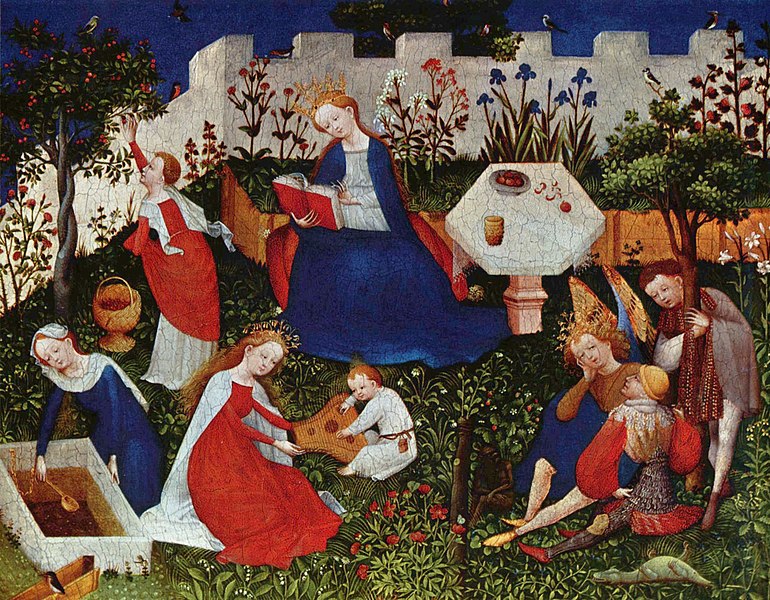
File:Meister des Frankfurter Paradiesgärtleins 001.jpg
German Garden, 1410.

Gardens and domestic outdoor spaces have always been a feature of our lives. Most Tudor homes had a garden of some sort, or else some land attached, even in the middle of a city like London. Their use was heavily dependent upon class, either to supplement the table and produce essential medicinal herbs or as arenas to display luxury and status. Native fruit and vegetables in season could make a huge difference to a lower-class family's diet and the cultivation and use of herbs, a remnant of the medieval monastic tradition, came from a rich oral tradition of home cures for every eventuality. Many were functional living spaces too, used for all manner of domestic work, including washing and drying, although fields outside the city walls were also emplyed in this way. Palace gardens were resplendent with statues and ornaments; the garden at Whitehall contained gilded heraldic beasts whilst at Kenilworth, the gardens became the famous stage for Elizabeth I's visit, remodelled with fountains, lake and island. There was little concept of garden design outside upperclass circles, with outdoor spaces being maximised for their productive abilites, as well as the exercise of man and beast. However, small knot gardens, full of scented herbs and plants were made along intricate lines and not beyond the reach of the middle classes. Their symmetrical designs, redolent of early Persian gardens, are the most archetypal of Tudor garden survivals.. 

A knot garden, recreated at the Garden Museum, Lambeth.


Seventeenth century gentlemen, returning from the grand European tour, brought back an appreciation of dramatic natural geographic features. "Sublime" mountains and Alpine-style lakes became all the rage. Mock Graeco-Roman ruins were imported into English landscapes, crumbling away among parks like that at Windsor. Completely new follies were built and artifically aged. Formal gardens betrayed Dutch and Italian influences too, balancing areas of symmetry and order with areas of wilderness to express the sublime power of the natural world. Specific areas were tamed into avenues, topiary creations, terraces and waterworks, whilst others, often distant were left to grow wild as described in Austen's Mansfield Park. Contained within the garden's confines, her jumbled-up pairs of lovers manage to contain their lusts but the temptation of entering the wildeness through the locked gate proves their undoing. Blenheim, Hampton Court and Versailles all demonstrate this balance between the careful, man-tamed environment and the wilderness beyond. It was to give an illusion of connection between the two, whilst allowing a degree of protection, that the sunken ditch known as the ha-ha came into use as a boundary. The garden became a playground, spurting jets of water among statues and using straight lines to create outdoor rooms. Poems by Andrew Marvell contrast the wild world inhabited by the mower with the formal yet playful environment of the great house. The abundance of flowers, fruit and vegetables he mentions are typical of the new methods of gardening, where exotic plants from the new world were grafted and unseasonably forced in large greenhouses and new colours blended and created. For the wealthy, it was an era of orangeries and tulips.


File:BadmintonMorris edited.jpg
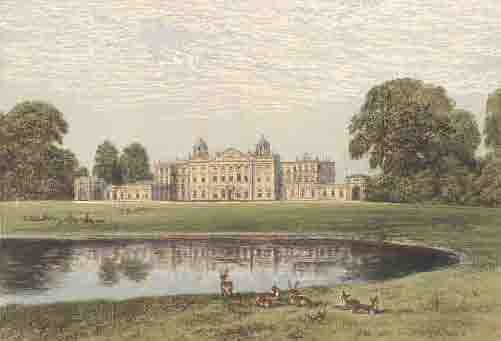
Badminton Morris House, Gloucestershire, with its deliberately "undesigned" park design.


The natural look became increasingly prevalent in the Eighteenth and early Nineteenth centuries, with vast parks being swept clean of unsightly features like villages; wavy lines, trees and grass growing freely with grazing sheep echoed an aristcratic preoccupation of the European bucolic ideal, such as epitomised in the novels of Anne Radcliffe, paintings of Claude Lorrain and romantics like Samuel Palmer and Caspar David Friedrich. Capability Brown worked on over 170 gardens in England during this time, advocating a "gardenless" form of gardening; his works survive at Coombe Park, Warwick Castle and Bowood House among others. Again, class was significant. Outdoor spaces became increasingly public and the vast parks of cities like London, Paris and Vienna became the locations for Sunday family promenades as well as political rallies.The old eighteenth century pleasure gardens, with something of an unsavoury reputation, as in Thackeray's Vanity Fair gave way to the more genteel tea gardens depicted by the Post-Impressionsts. Huge market gardens produced fresh fruit and flowers which the spread of railways allowed to grace city dining tables of the rich. With more produce becoming available, gardens became increasingly about relaxation and the achievement of a casual, meadow-style look. Native plants were sown with apparent abandon, to create the impression of self-seeding in what was actually careful planning, by cottage-garden designers such as Gertrude Jekyll. Her romantic, pretty planting with its subtle colours and blowsy borders was developed by other early twentieth century enthusiasts like Vita Sackville-West. The romance and escape of gardens was popularised by the 1909 best selling "Elizabeth and her German Garden" and its sequels, by Elizabeth von Arnim.

File:Jekyll Manor House Border.jpg
Gertrude Jekyll border at Manor House, Upton Grey, Hampshire

The Twentieth century saw garden design becoming increasingly architectural. Unusual features and play between the natural and man-made are popular again, as any visit to Hampton Court Flower show will demonstrate. Large panels of synthetic materials in bright colours sit along side rustic-style modern follies, whilst a wealth of innovative planting allows for exciting contrast and variety in texture, scent and colour. Features like decking, patios and planting boxes allow even small gardens to maxmise their space, providing an extra room in over-crowded urban areas. The popularity of conservatories has seen them change from the overwhelmingly green waxy-leaved hot houses of the Victorian upper classes, with their heavy furniture, to lighter, open spaces that combine the best of indoor and out. Cheap garden fittings, furniture, plants and barbeques encourage us to get outside as much as possible, whilst TV makeover and DIY programmes give cheap inspiration regarding the transformation of our backyards. In a complete reversal from their use by our grandparents, to house Anderson shelters and dig for victory, gardens have become our arenas for experimentation and self-expression. In the modern garden, anything goes.

File:Reva-10208.jpg
Electric car on display at the 2009 Hampton Court Flower Show